

This was reported in the Alpirsbach town newsletter, issue no. 23, on June 8, 2012. Mr. Hartmut Knortz, after intensive work, has transformed a very old, almost dilapidated building into a gem. Heartfelt thanks are extended for the dedication shown by him and his wife, Nora.
How old is this building? We don't know exactly, but we can provide some information that goes back over a quarter of a millennium. In 1805, it was described as follows:
An extension to building number 135 (= Gerbergasse 20), containing an apartment above and a tanner's workshop below, is situated between the street on one side and Andreas Köbelen's garden on the other. It abuts the residence of Jerg Faßnacht at the front and the dwellings of Andreas Köbelen and Ludwig Weitbrecht at the rear. This building was previously a butcher shop owned by Sigmund Leibiger, but later converted into a saddler's workshop by Christoph Leibiger.
In 1784, Gabriel Köbele altered this building, adding an extension to the house, a small room and chamber upstairs, and a tanner's workshop downstairs, for which he obtained the timber from the monastery's forests. (Timber report 1784, fol. 42b.).
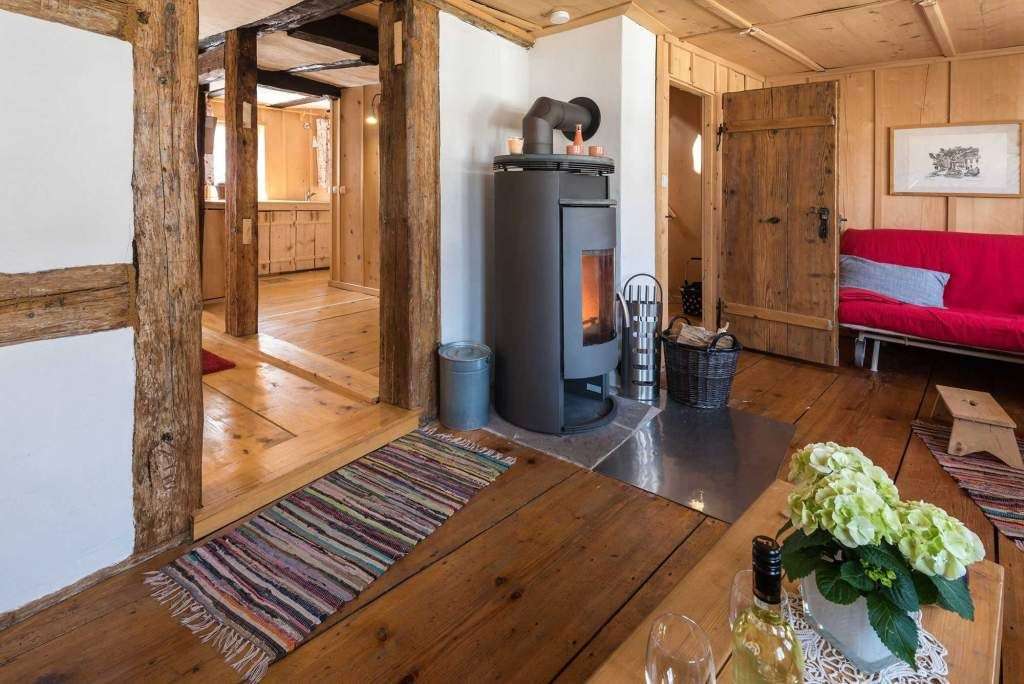
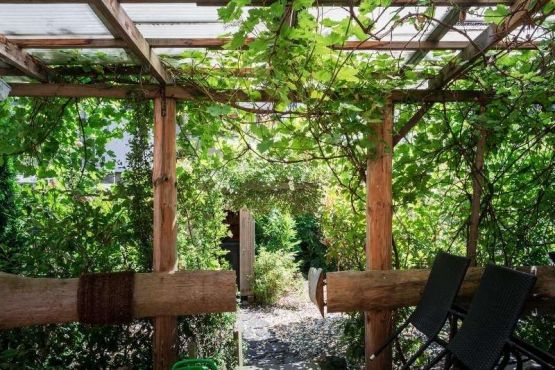
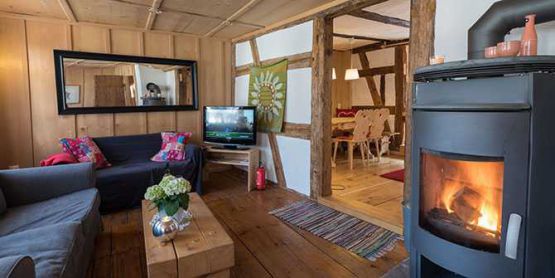
This historic tanner's house is a wonderful holiday home that will transport you back in time, yet also offers modern comforts, including a sauna and a lovely little garden. It's within walking distance, yet quiet, in the old town right on the Kinzig River.
Owner Andreas Köbele, formerly Gabriel Köbele.
The building owner, like almost all citizens of Alpirsbach, Rötenbach, and Reutin, was therefore entitled to purchase timber worth two-thirds of the current price. The timber records of the monastery office have been preserved in the Stuttgart State Archives and are a treasure trove for historians of houses and families.
A little tip: If you love historic holiday homes, then take a look at the holiday apartment in Rottweil in the historic Vogtshof and the manor house Hofgut Bärenschlössle - the holiday home in Freudenstadt .
In the lintel of the house entrance, alongside the tanners' guild symbol and the year 1783, the letters G and K can be read, standing for Gabriel Köbele. The discrepancy between written records and the house inscription can be explained by the fact that the building's renovation lasted from 1783 to 1784.
The personal details match the entries in the Alpirsbach church registers, which senior teacher Georg Albrecht (1881-1964) evaluated in an exemplary manner.
Let us begin with the butcher Sigmund Leibiger (born 1713). In 1746, he married Maria Margareta, a daughter of the tailors' guild master Johann Friedrich Wörner. Their marriage produced ten children, of whom the sons Georg Jakob settled in Frankfurt, while Gottlieb Heinrich settled in Brabant.
The Leibiger family were attracted by the silver and cobalt mining industry in Wittich and Reinerzau, which had flourished since the beginning of the 18th century, drawing on the depleted mines in Saxony (Ore Mountains) and Thuringia (Harz Mountains). As recognized experts, they found suitable employment. The Leibiger family is the most famous example of this.
Sigmund's father was Konrad Leibiger (1695-1744), a mine foreman at the "Güte Gottes" mine in Wittichen; his mother was the daughter of the carpenter Friedrich Maser. "He was only 21 years old when he married, born in Neuenstadt, now Neustädtel, near Schneeberg, where his father, Alexander Leibiger, was a citizen, and later in Eckershausen, Principality of Eisenach. Neustädtel and Schneeberg are towns that grew entirely from mining and have now merged. The main mines there yielded cobalt and silver, just like Alpirsbach, Reinerzau, and Wittichen. They are located very close to Aue, the now famous or infamous uranium ore mining area." (Georg Albrecht). Of Konrad's twelve children, most died young; only Sigmund and Karl Friedrich (a baker) were able to start families.
Christoph Friedrich Leibiger (1749-1794), Sigmund's eldest son, had become a saddler and established a saddlery workshop in accordance with his profession. He must have had enough customers for his products, as there were still plenty of horses and cows in Alpirsbach and its (monastery) administrative districts at that time.
With his wife Elisabeth Barbara, a daughter of the gatekeeper Johann Christoph Schneider, he had six children. The office of monastery gatekeeper is documented from the second half of the 16th century. In 1619, "Gatekeeper" Hans Schwenk, who had been employed at the monastery for over 40 years, died. His duties beyond opening and closing the two gates (the upper one between the main office and the brewery, the lower one by the former hospital) are unknown. He was a son of the monastery cooper Johann Friedrich Schneider (1722-1765).
His father, Johann Schneider (1684-1771), had already been a monastery cooper. As a reminder: the grape must harvested in the Breisgau region was processed in Alpirsbach. What remained after the wine paid to officials and priests was sold.
The Köbele/Köbelin family has been documented in Alpirsbach since 1701. At that time, the tanner Gabriel Köbele (1666-1735) married the baker's daughter Sabina Barbara Hetzel, who died later that same year at the age of 22.
From his second marriage to Jakobina Mick, presumably born in Nordweil/Breisgau, came, among others, a son, Matthias Köbele, who worked as a tanner, was also a foreman at the Eberhard and Unverhofft Glück mines, and later served as a messenger. Born in 1707, he married Sophia Elisabeth in 1735, a daughter of Daniel Zobel, the Fürstenberg mining master from Wittichen.
Matthias K.'s brother was Georg Jakob Köbele (1717-1777), also a tanner and a member of the local council. His son Gabriel Köbele was born in 1758 to Agnes Margareta Stortz (1721-1789), the daughter of a stocking weaver. Gabriel died unmarried in 1784 and thus did not live to see the renovations completed. His brother Andreas then took over the property (see below).
The neighbors of the two Köbeles were Hannß Jerg Faßnacht, Andreas Köbele, and Ludwig Weitbrecht. Johann Georg Faßnacht (1749-1789) was a tanner. His father came from Reutlingen. He himself had twelve children with Christina Maria Adrion (1753-1818), the daughter of a blacksmith from Alpirsbach. Most of them found work elsewhere, such as his sons Johann Christian and Gottlieb in Switzerland.
Let our website inspire you for your family vacation with children. Find out more about our vacation apartments and houses for your holiday with kids. Subscribe to our newsletter and receive our 30-page e-book with our personal insider tips for your family getaway.
By submitting this form, you consent to receiving advertising and informational material about our services via email. You can object to the use of your email address at any time free of charge by using the unsubscribe link included in our emails or by sending a message to info@schwarzwald-ferienhaus.net. Further information can be found in our privacy policy.
Andreas Köbele (1762-1819) was married twice, first to Anna Maria Trautwein (1765-1805), and after her death to Cordula Wössner, a daughter of the farmer Matthäus Wössner from Dieboldsberg. Anna Maria came from a large and widespread family in Schiltach. Her father, Johann Georg Trautwein, was an ironmaster and tanner.
Johann Ludwig Weitbrecht (1740-1806), a son of the customs officer Johann Jakob Weitbrecht (1704-1778), was a tailor and married Johanna Christina, the daughter of the master tailor Hans Friedrich Wörner, who died at the advanced age of 81 in 1819. She was a sister of the wife of Sigmund Leibiger (see above).
Now we can look forward to the “Open Monument Day” on September 9th, when the couple Hartmut and Nora Knortz will open the Gerberhaus to all interested parties.
Sources:
Description of the buildings and farmsteads entitled to the use of timber rights, 1805 (Alpirsbach City Archives)
Georg Albrecht: Alpirsbacher Familien I-IV n.d. (Archive of the Protestant Parish Office Alpirsbach).
This text is published here with the kind permission of Karl-Martin Hummel.
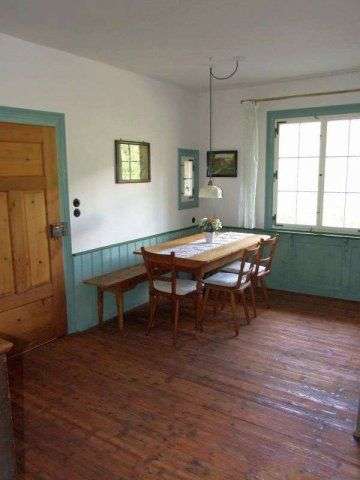
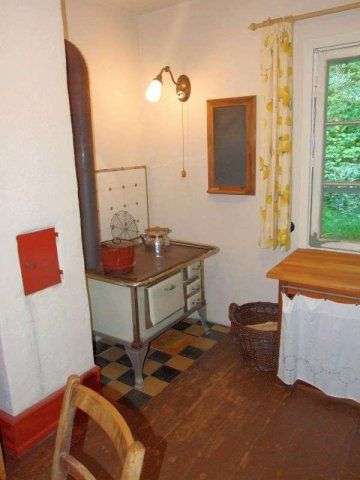
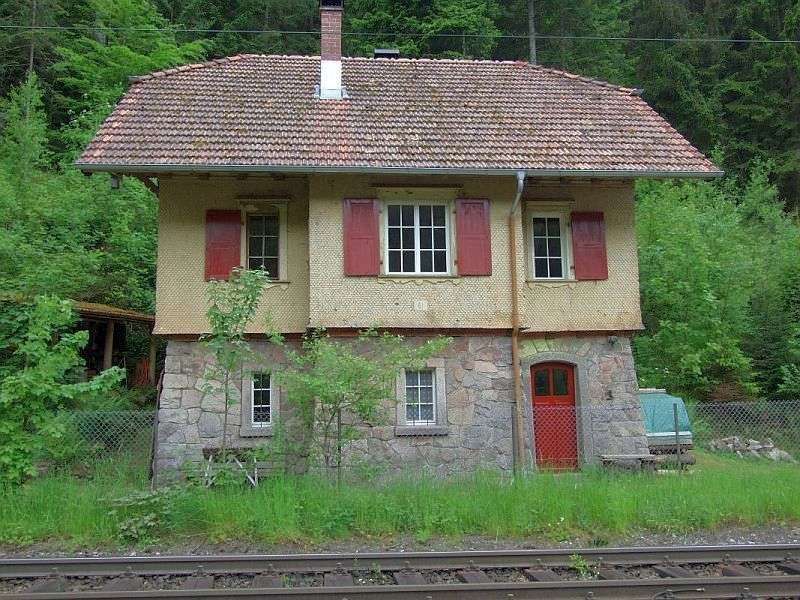
The former signalman's post WP 61 on the Black Forest Railway has been lovingly and carefully renovated to offer its guests a unique journey back in time. The concept, "Holidays in a Listed Building," is based on preserving the original condition of the historic structure, thus providing a one-of-a-kind living experience.
The house is in a secluded location directly next to the railway line above 78098 Triberg-Gremmelsbach.
More information: www.ferien-im-baudenkmal.de
Heiko Roth
Schillerstraße 62
72275 Alpirsbach
Telephone: +49 7444 4130
Email: anfrage@schwarzwald-ferienhaus.net