

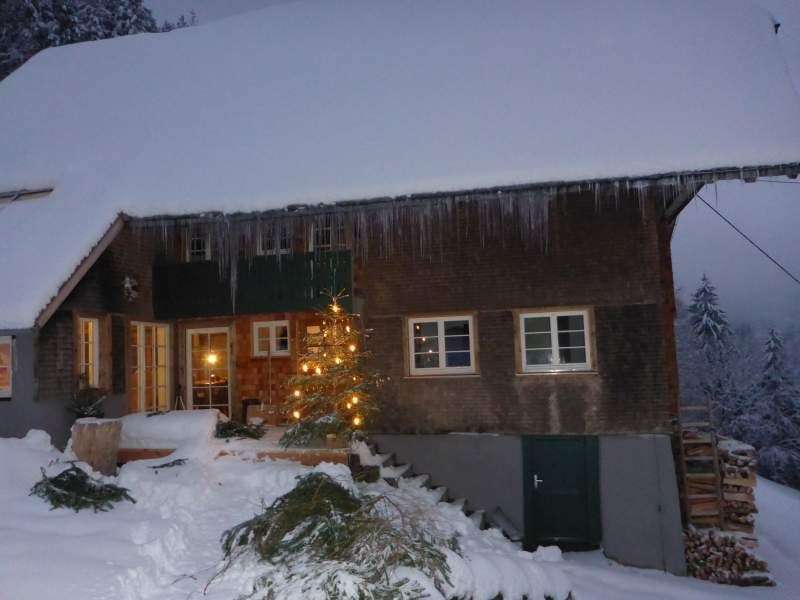
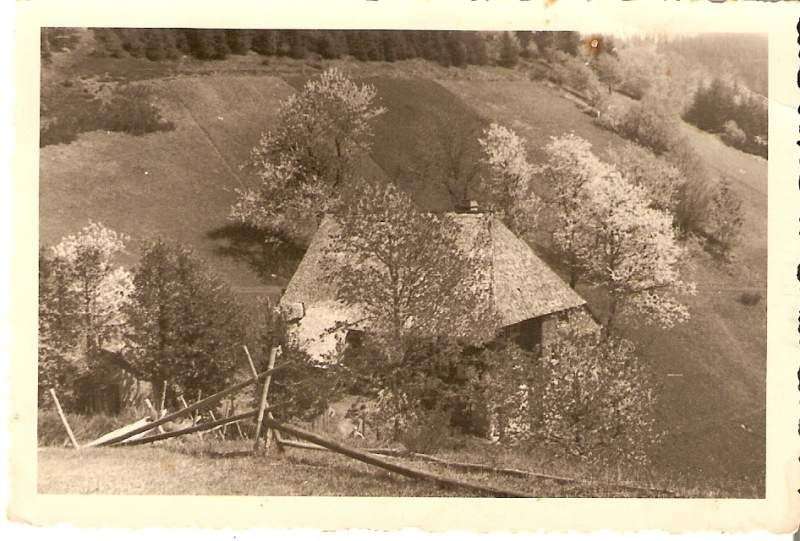
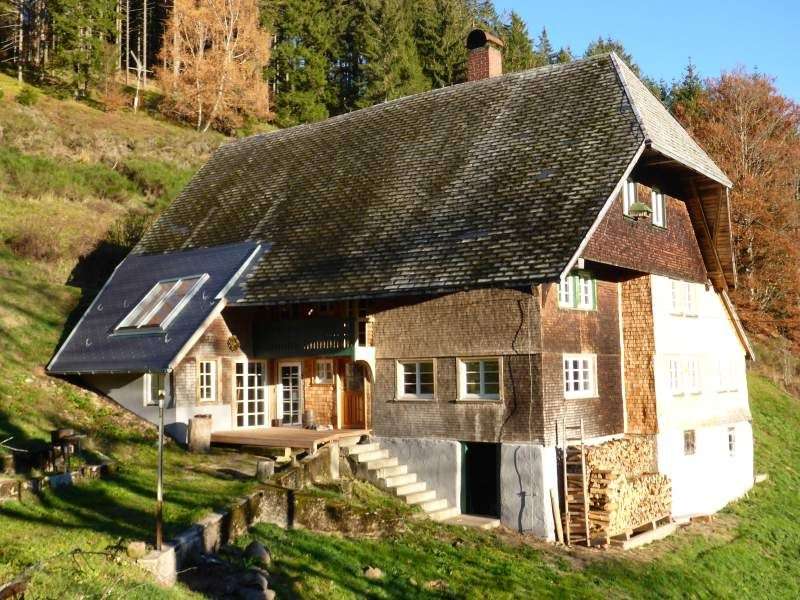
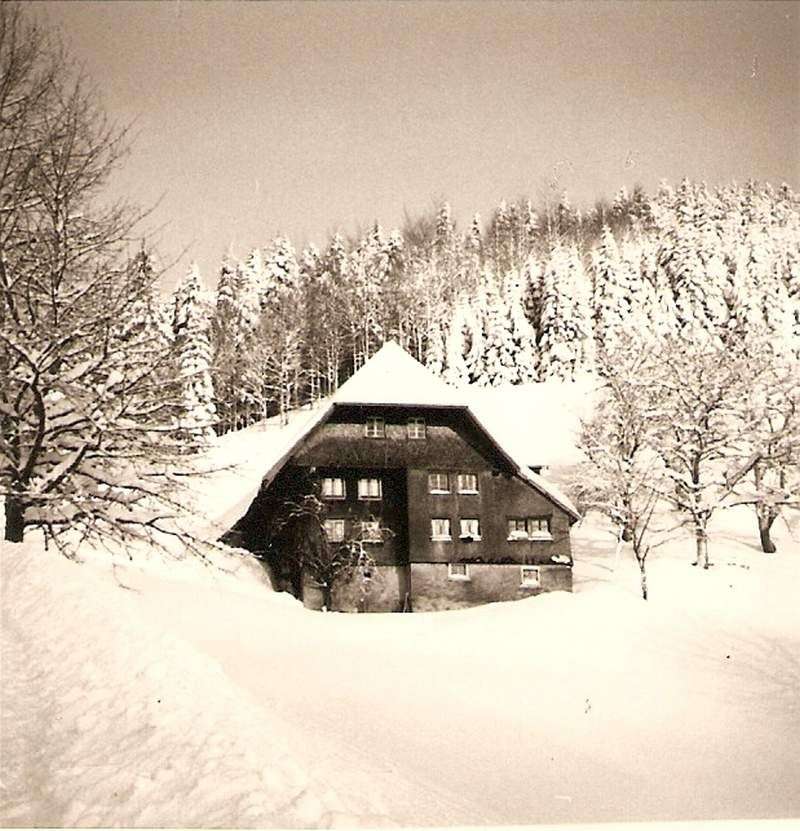
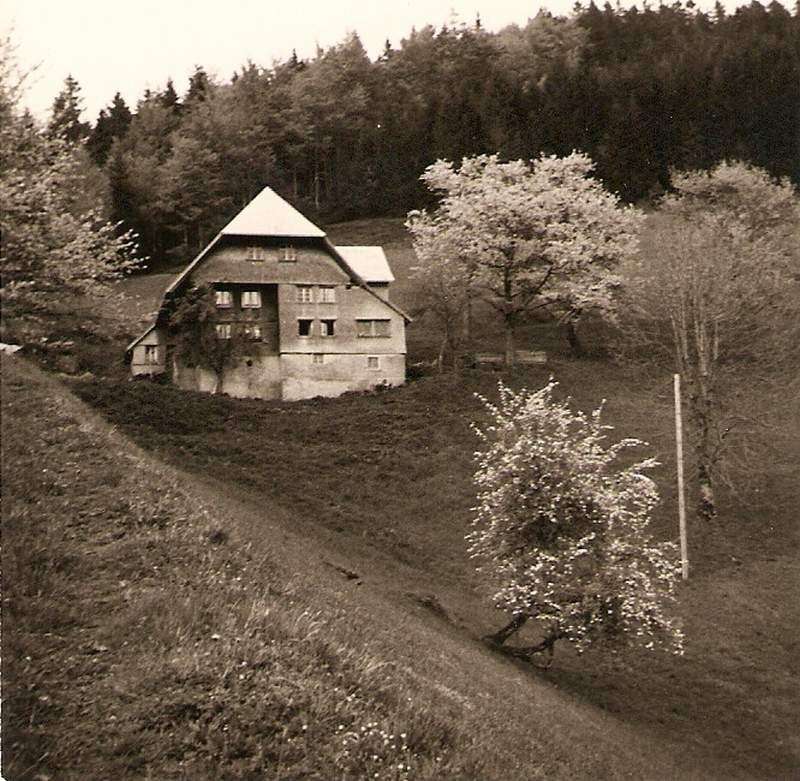
Kasper's cottage was built in 1716 by Kasper Fehrenbach. Kasper Fehrenbach was the sixth son of Hans Fehrenbach, a farmer at the Königenhof estate. The Königenhof estate in the Wagnerstal valley was destroyed by an avalanche on February 24, 1844. Seventeen people lost their lives in this disaster. Hans Fehrenbach actively promoted the private settlement of the Wagnerstal valley. Seven of his children settled there, including "Casper Fehrenbach." Kasper Fehrenbach, born September 20, 1671, died September 25, 1735. On October 18, 1702, he married Margarete Hug, the daughter of the bailiff of Wildgutach. In 1707, by clearing land "in the Knöbelwald" forest at the boundary of the Wagnerstal valley, he established the smallholding named after him, Kaspel-Gütle, where he built his house in 1716. The following text was carved into the bow on the west side by the carpenter: " CASPER FERENBACH HAD THIS HOUSE BUILT MARCTCRET HIDEMARI HERMAN SPANMAISTER 1716".
The Königenhof farmstead in the upper Wagnerstal valley, an hour and a half from Neukirch, stood on the winter side of a steep mountain face. The farmhouse, with its barn and stable, was very large, built entirely of wood, and quite old. The entrance and barn were situated on the side of the Steinberg, the highest mountain in what was then the Triberg district. Thirty-two paces up the valley were the two-part houses of the clock-frame maker Philipp Beha and the roofer Johann Löffler, and the same distance away, on the opposite side of the valley stream, was the house of the widow Blasius Faller. The following account is based primarily on the Triberg district office records. At that time, the farmhouse was home to the family of Martin Tritschler with eleven of his twelve children and his mother-in-law, and in the rear part of the building lived the tenant farmer Hilar Winterhalter with his wife and four children, as well as his sister-in-law with one child—a total of 22 people. Martin Tritschler, the farmer at Königenhof, had only minor debts. In February 1844, the snow on the steep, bare slope lay, as knowledgeable people assured us, 6 to 14 feet deep, depending on how the wind had piled it up. On Saturday, February 24, 1844, a sudden change in the weather occurred; it rained all day into the deep snow. At 6 p.m., a blizzard behind the house (west side) swept away the beehive. The women expressed their concern about the house, but the men said that the snow could not harm the large building.
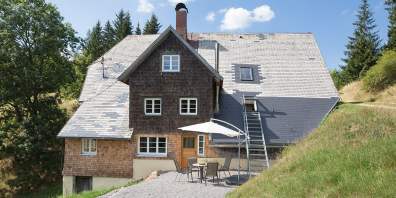
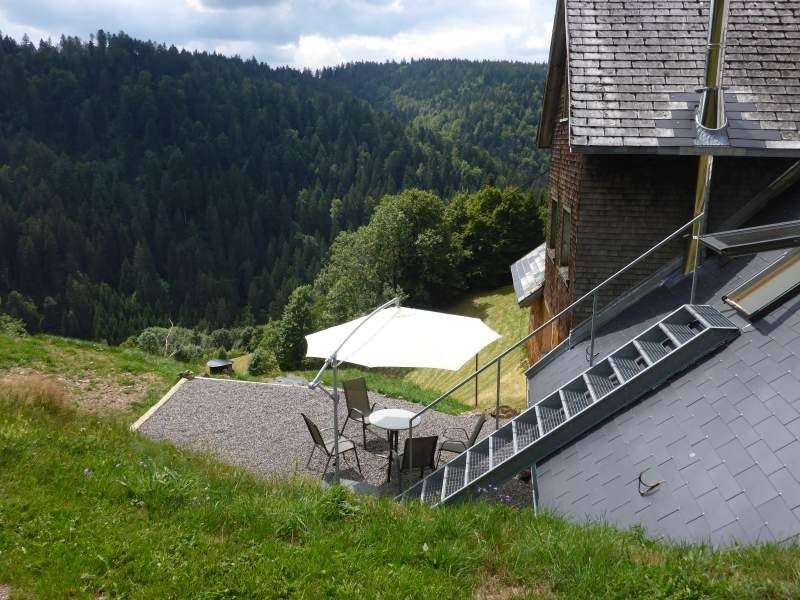
Kaspershäusle also houses a beautifully renovated holiday apartment equipped with every comfort. Here you can escape from everyday life in the great outdoors, surrounded by nature and the forest. Truly in the heart of the woods.
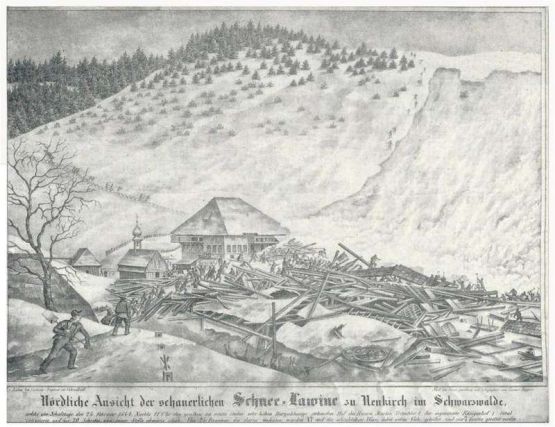
The avalanche disaster and the destruction of the Königshof farm were described in the Neukirch community's farm chronicle as follows:
"The Downfall of the Royal Court"
Source: "From the history of Neukirch, farm chronicle of a Black Forest community" Published by the municipality of Neukirch, 1968.
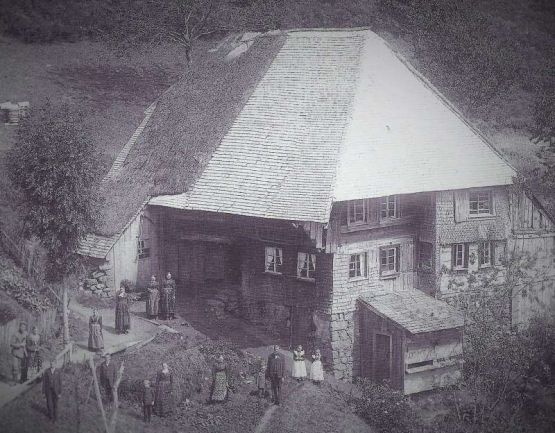
In the neighboring house, the two sons, Blasius and Philipp Beha, worked until around 9 p.m. and then came into the farm building to play cards with the farmer, his sons Lorenz and Thomas, and the cottager Hilari from Kurzweil, as they often did. Around the same time, the other residents of the house went to bed.
As the surviving daughters later testified, they were awakened at night, around 11 p.m., by a terrible crash. A wide avalanche of snow had pushed the entire building from its foundations on the mountainside, carried it 16 paces downhill, and thrown the west side of the roof over the house, crushing the whole structure. The room where the sisters Bibiane and Martha slept collapsed into the barn onto the livestock, where the girls could only lie or sit huddled together in a hollow space, unable to escape.
Sister Elisabeth and Theres, who were sleeping in another room, were also buried under so much snow and debris that they could no longer move. Around 11 o'clock that night, Philipp Beha's wife heard a shuddering sound, like a sudden gust of wind, and felt her house tremble. She didn't dwell on it, however, as it was a very stormy night. At 4 o'clock, she got up to cook breakfast because her two sons were supposed to be carrying clock frames to Urach. When the couple couldn't find their sons, they looked out the window but could no longer see any of the windows of the Königenhof and thought the snow had piled up so high that even the second-story windows were no longer visible. Philipp Beha ran over to the courtyard but saw only a heap of snow instead of the house and therefore woke his housemate, Johann Löffler. The married couple Beha and Johann Löffler went back to the Königenhof with lights and lanterns, and when they called out to see if anyone was still alive, their daughters replied: "We four are still alive." They asked to be lifted out, as they didn't know where to go.
While Johann Löffler went to Kajetanshof, a quarter of an hour away, for help, Bibiane, following Mrs. Beha's shouts, worked her way through snow and wood, finding a way out either against the entrance or against the mountain. Her siblings, who were sleeping in the same room as her, were rescued after the first helpers arrived at the scene of the accident.
The rescued were given clothing at Philipp Beha's house. The farmer's servant had notified Mayor Auber of the accident at 6:30 a.m. The mayor then informed the priest. More and more people arrived.
But the rescue efforts were hampered not only by the high pile of rubble, in which the timbers lay crisscrossed, but also by a sudden cold snap that froze the wet snow into an iceberg. Inside the farmhouse, besides the belongings, were 300 to 400 hundredweight of hay, a considerable amount of straw, and all the fruit. Recovering the dead took several days.
The avalanche claimed several victims:
1. Farmer Martin Tritschler, 60 years old
2. his wife, Wallburga née Heitzmann, 50 years old
3. whose mother Maria Faller from Urach, 70 years old
4. Lorenz Tritschler, 23 years old
5. Fidel Tritschler, 14 years old
6. Maria Tritschler, 19 years old
7. Magdalena Tritschler, 13 years old
8. Hilar Winterhalter, 30 years old, a stay-at-home dad
9. whose wife Klara née Hofmeier, 28 years old
10. whose children Wilhelmine, 5 years old, and
11. Balbina, 3 years old
12. Salomon Hofmeier, one year old, all laid out on boards in the large court chapel
13. Philipp Beha, 20 years old, who cried out for a long time, was only rescued alive on Sunday afternoon at 3 o'clock, but died half an hour later, lying in state in his parents' house,
14. Theresia Tritschler, 15 years old, succumbed to her serious injuries on February 27th on Jägerstieg, where she had been taken to relatives the day before
15. Katharina Hofmeier, mother of 12, sister of 9, 21 years old, was found dead in the rubble on February 27th at 7 pm
16. Blasius Beha, 23 years old, found dead in his living room on the evening of February 28th,
17. Thomas Tritschler, 18 years old, was found dead in his room on the evening of February 29th.
Let our website inspire you for your family vacation with children. Find out more about our vacation apartments and houses for your holiday with kids. Subscribe to our newsletter and receive our 30-page e-book with our personal insider tips for your family getaway.
By submitting this form, you consent to receiving advertising and informational material about our services via email. You can object to the use of your email address at any time free of charge by using the unsubscribe link included in our emails or by sending a message to info@schwarzwald-ferienhaus.net. Further information can be found in our privacy policy.
The dead from the Königenhof farm were transported to the cemetery in 16 sleds and buried in a common grave. Of the 24 people in the house, only seven survived the disaster: the daughters Elisabeth (22), Bibiane (21), and Martha (16); the ten-year-old twin brothers Leo and Julius; and Paul and Anton Winterhalter (9 and 6 years old). The farm also had 28 head of cattle and 2 horses. Although most of the livestock were still alive when they were pulled from the wreckage, they then had to be slaughtered on the spot by five butchers.
This may have further intensified the impression of horror. One horse, two young bulls, one heifer, two calves, four sheep, and four goats were rescued. The farmhouse was insured for 3150 florins, but could hardly have been rebuilt for twice that amount.
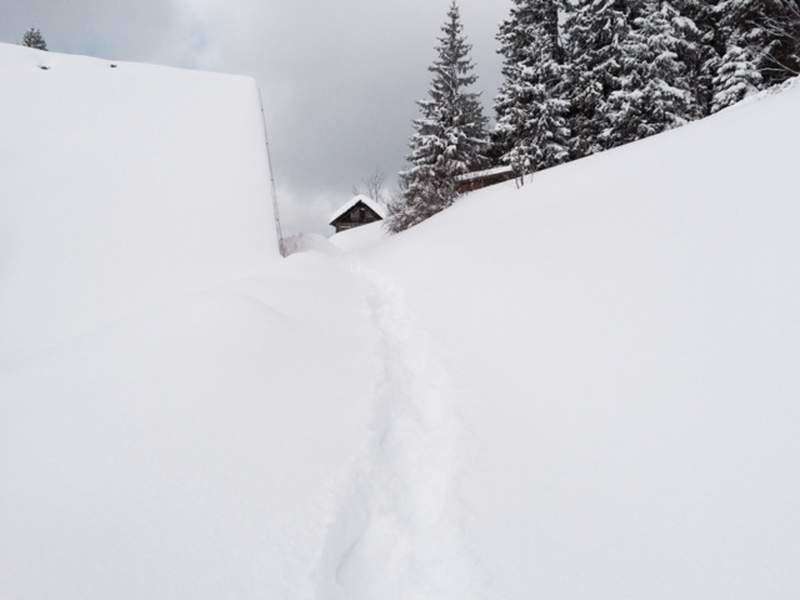
The accident would not have occurred if the steep mountainside above the house had still been covered with trees. To prevent similar accidents, it was recommended that the new house be built on the sunny side of the mountain.
The Wagnerstal disaster had a widespread impact. Church collections were held in the districts of Triberg, Villingen, and Neustadt. In Donaueschingen, the court orchestra organized a benefit concert for the orphans. On March 8, 1844, the Grand Duke granted 500 florins from his personal funds to support the affected families, and the Prince of Fürstenberg also donated 500 florins. Andreas Bäuerle, a farmer from Oberwolfloch who also suffered snow damage, declined a share of the donation out of "noble, philanthropic sentiment." Two months after the disaster, Pastor Schilling wrote: "The Tritschler family's older children are wandering homeless.".
On July 21, 1844, the municipal council and the foundation's board decided to erect a memorial in the cemetery for those who died in the avalanche, a memorial that still commemorates the victims today. The cost of 150 florins was paid from collections donated throughout the region.
The caretakers of Martin Tritschler's heirs – Georg Heintzmann from Bad Urach and Rößlewirt Anton Rombach – sold on July 15, 1844 to Paul Löffler, Kajetanshof:
1. The chapel built of wood with a granary built on top of it.
2. The small farm mill located below this chapel,
3. The wood from the collapsed farmhouse,
4. The following areas: 11.6 Morgen arable land, 14.6 Morgen meadows, 132.5 Morgen pasture, 53.3 Morgen woodland in the rear Wagnerstal valley, for 8830 fl.
According to a deed of sale from 1798, Johann Löffler owned half a small house on the farm. Georg Hermann had the right to collect wood, and according to a deed of sale from 1805, Philipp Beha had grazing rights. Paul Löffler, a farmer from Kajetan, wanted to rebuild the Königenhof.
The timber was already on hand, but Paul Löffler's early death thwarted the construction project. The avalanche disaster at Königshof continued to stir emotions for a long time. In 1908, the forestry authority erected a memorial plaque at the former farmstead
Heiko Roth
Schillerstraße 62
72275 Alpirsbach
Telephone: +49 7444 4130
Email: anfrage@schwarzwald-ferienhaus.net